Here in our part of the world in North Texas, grass fires can flare up at any time, especially during the Summer when it’s hot, dry, and the wind is blowing. Years ago, I read about a large grass fire that swarmed a neighbor’s farm. It took firefighters most of the day to finally get it contained. Days after the fire had been extinguished, it fired back up for no apparent reason. Firefighters realized the tree roots underground had become so hot during the original fire when hot dry air accompanied by winds and low humidity had settled into the area, it provided the perfect conditions for the smoldering embers underground to ignite. Bitterness and anger that has not been dealt with are like that smoldering fire. On the outside, everything seems good. However, deep down in the roots of the heart and mind, the embers of bitterness smolder, waiting to be set ablaze by just the right comment or reminder of someone who has offended us.
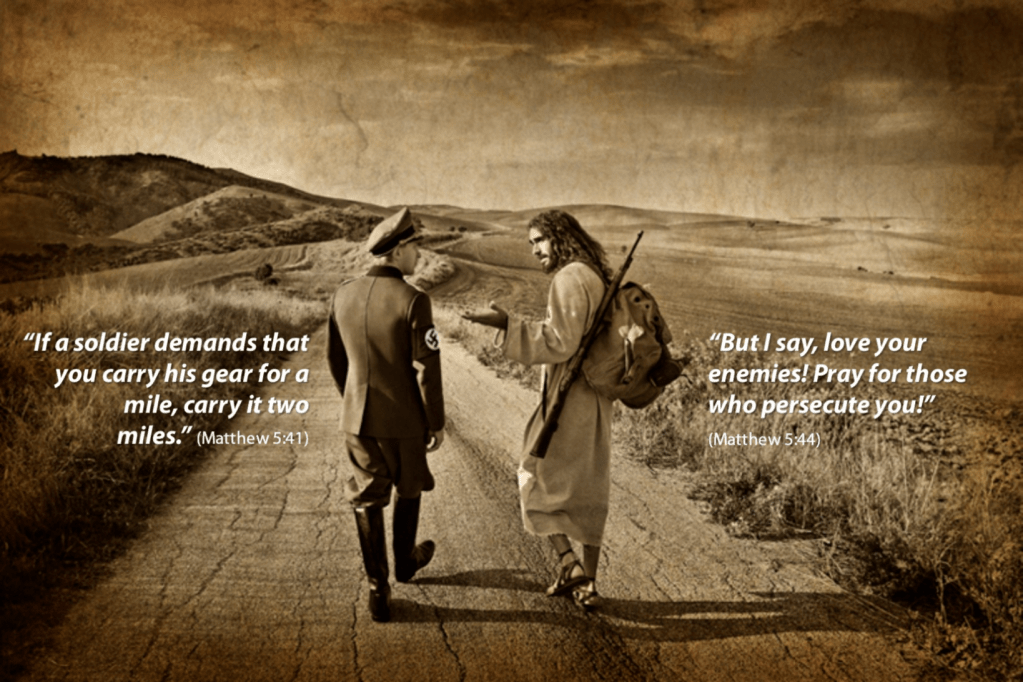
Like the picture of Jesus walking beside a German soldier down a long and dusty road, forgiveness is a word that can somehow strike fear in us. “Forgive them? Are you serious? Are you freaking crazy! If you only knew what they did to me! To my family! To my business! How they hurt me.” And yet, God asks us to forgive.
To forgive or not to forgive is something everyone wrestles in life. Perhaps you grew up in a home where hurts and offenses are held onto and even held over you. Maybe a friend or co-worker or relative or spouse has offended and hurt you so deeply that letting go of the pain means letting go a part of yourself. It’s like we keep hurts and faults in a little plastic bag, so they stay fresh and when we feel the time is right, we take those injuries and offenses out of the bag, and relive the pain as if it just happened, and we make everyone involved, including ourselves, suffer through it again.
When the Apostle Peter asked Jesus, “Explain this parable about what defiles a person” [Matthew 15:15], Jesus answered: “19 For out of the heart come evil thoughts and plans, murders, adulteries, sexual immoralities, thefts, false testimonies, slanders (verbal abuse, irreverent speech, blaspheming). 20 These are the things which defile and dishonor the man.” [Matthew 15:19-20 (AMP)]. The Apostle Paul wrote, “Let all bitterness and wrath and anger and clamor [perpetual animosity, resentment, strife, fault-finding] and slander (evil-speaking, abusive or blasphemous language) be banished from you, along with every kind of malice [all spitefulness, verbal abuse, ill will, malevolence intent]” [Ephesians 4:31 (AMP)]. Both Jesus and Paul make the point that bitterness, anger, and resentment — unforgiveness — affects who we are and how we behave. The roots of unforgiveness sprout bitterness and anger and feed on continuous animosity, resentment, strife, fault-finding, and slander. When unforgiveness takes root, we find ourselves speaking evil and abusive words fueled with every kind of malice, spitefulness, ill will, and malevolence intent. All of which defiles and destroys a person and relationships.
The Bible is full of men and women whose families were dysfunctional and themselves misfits. They knew what it’s like to need forgiveness and the need to forgive and to forgive themselves.
* Noah was a drunk (Genesis 9:21)
*Jacob was a liar. (Genesis 25:26-34)
*Joseph was abused by his family and sold into slavery. (Genesis 37:18-36)
*Samson was an angry vengeful womanizer. (Judges 13-15)
*Rahab was a prostitute. (Joshua 2)
*King David was a liar, an adulterer, and a murderer. (2 Samuel 11)
*Elijah suffered from depression and was suicidal. (1 Kings 19:3)
*Isaiah preached naked. (Isaiah 20:1-2)
*Peter denied Christ… three times. He embarrassed the disciples and said things he shouldn’t. (Luke 22:54-62)
*The Samaritan woman at the well had multiple partners. (John 4:17-19)
Look, I’m no expert on forgiveness, but I do know what it’s like to forgive and be forgiven. What I have found to be true is this, without a divine transformation authentic forgiveness is incomplete. All of the lives above (and countless others throughout time) eventually found life worth living — they found forgiveness. Forgiveness that came through a holy, loving, and just God. When the power of forgiveness is applied by the Holy Spirit, the power of forgiveness, then, flows from God to you, then, from you to others, and, mercifully, to yourself. That kind of forgiveness is life-changing. Life-altering. Life-giving.
When I choose to become a Christ-follower, something amazing happened. What God promised through Ezekiel the Apostle Paul became true: “I will give you a new heart and put a new spirit within you, and I will remove the heart of stone from your flesh and give you a heart of flesh. 27 I will put my Spirit within you and cause you to walk in My statutes, and you will keep My ordinances and do them” [Ezekiel 36:26-27 (AMP)]. The Apostle Paul wrote, “17 When someone becomes a Christ-follower, he becomes a brand new person inside. He is not the same anymore. A new life has begun! 18 All these new things are from God who brought us back to himself through what Christ Jesus did. And God has given us the privilege of urging everyone to come into His favor and be reconciled to Him. 19 For God was in Christ, restoring the world to himself, no longer counting men’s sins against them but blotting them out. This is the wonderful message He has given us to tell others.” [2 Corinthians 5:17-19 (NLT)].
“Psychologists generally define forgiveness as a conscious, deliberate decision to release feelings of resentment or vengeance toward a person or group who has harmed you, regardless of whether they actually deserve your forgiveness” (Greater Good Science Center at UC Berkeley). Just as important as defining what forgiveness is, though, is understanding what forgiveness is NOT. Experts who study or teach forgiveness make clear that when you forgive, you do not gloss over or deny the seriousness of an offense against you. Lewis B. Smedes in his book, “The Art of Forgiveness”, gives us an idea of what forgiveness is NOT: “Let me make sure that we clear up a few misunderstandings about forgiveness. Before we can build, we have to blast. We have to blast away the erroneous thoughts on what forgiveness is not.
1. When we forgive a person, this does not mean we are immediately healed.
2. When we forgive a person, this does not mean we are going to be buddy/buddy.
3. When we forgive a person, this does not mean we surrender the right to restitution or justice when appropriate.
4. When we forgive a person, this does not mean that we trust them, yet.
5. When we forgive a person, we are not avoiding pain, we are opening the door to healing.
6. When we forgive, we take the journey at the pace we are able to handle… the deeper the hurt, the longer the journey.”
The Apostle Paul had the right idea when it came to forgiveness: “I don’t mean to say that I have already achieved these things or that I have already reached perfection. But I press on to possess that perfection for which Christ Jesus first possessed me. No, dear brothers and sisters, I have not achieved it, but I focus on this one thing: Forgetting the past and looking forward to what lies ahead, I press on to reach the end of the race and receive the heavenly prize for which God, through Christ Jesus, is calling us. Let all who are spiritually mature agree on these things. If you disagree on some point, I believe God will make it plain to you. But we must hold on to the progress we have already made. Dear brothers and sisters pattern your lives after mine and learn from those who follow our example. For I have told you often before, and I say it again with tears in my eyes, that there are many whose conduct shows they are really enemies of the cross of Christ. They are headed for destruction. Their god is their appetite, they brag about shameful things, and they think only about this life here on earth. But we are citizens of heaven, where the Lord Jesus Christ lives. And we are eagerly waiting for Him to return as our Savior. He will take our weak mortal bodies and change them into glorious bodies like His own, using the same power with which He will bring everything under His control.” [Philippians 3:12-21 (NLT)]
That picture of Jesus and the German soldier walking down that long dusty road hangs on my office wall. It reminds me that no matter what state I find myself in, Jesus is willing and able to put my life back together through the healing of forgiveness. I’ve often thought to myself, “What was that was that walk like? What would that soldier and Jesus have talked about? How did Jesus make that (many would include the word ‘disgusting’) soldier feel?” Jesus was the perfect example of how to begin to forgive others and yourself. He said: “41 If a soldier demands that you carry his gear for a mile, carry it two. 42 Give to those who ask, and don’t turn away from those who want to borrow. 43 “There is a saying, ‘Love your friends and hate your enemies.’ 44 But I say: Love your enemies! Pray for those who persecute you!” [Matthew 5:41-44 (AMP)] I have a feeling Jesus and the soldier talked about life, healing, and… forgiveness.
At Cold Dead Hands religion doesn’t define us, Jesus Christ does. Religion shackles and enslaves folks. Religion manipulates people. As “Christ-followers,” faith lies in our relationship with Jesus Christ and the tenants Christ laid out in both the Old and New Testaments. We would never claim perfection, but we do know forgiveness that runs through Christ and His cross. Like our founder, Patrick James, is fond of saying: “Being a follower of Christ isn’t about being perfect… I’m just an imperfect guy, living in an imperfect world, trying to serve a Perfect Christ. It’s not easy… but it makes a difference in my life. It helps highlight truths… and it helps me to be a better person tomorrow, than I was today.”
Do something extreme today. Let it begin with loving your enemies by praying for those who have mistreated you. As you pray, remember, sometimes the enemy is you.
If you are not a Christ-follower, know that we would never infringe on your right to believe differently than us. In fact, we love hearing from every sector of our readers. Your questions and comments are important.
In the meantime, I’ll leave you with these lyrics. The song is called, “God Only Knows” and it was recorded by the band, For King & Country. It would be worth your time to listen to it on YouTube.
“Wide awake while the world is sound asleepin’
Too afraid of what might show up while you’re dreamin’
Nobody, nobody, nobody sees you
Nobody, nobody would believe you
Every day you try to pick up all the pieces
All the memories, they somehow never leave you
Nobody, nobody, nobody sees you
Nobody, nobody would believe you
God only knows what you’ve been through
God only knows what they say about you
But God only knows the real you
There’s a kind of love that God only knows
There’s a kind of love that
There’s a kind of love
You keep a cover over every single secret
So afraid if someone saw them, they would leave
But somebody, somebody, somebody sees you
Somebody, somebody will never leave you
God only knows what you’ve been through
God only knows what they say about you
God only knows how it’s killing you
But there’s a kind of love that God only knows
God only knows what you’ve been through
God only knows what they say about you
But God only knows the real you
There’s a kind of love that God only knows
For the lonely, for the ashamed
The misunderstood, and the ones to blame
What if we could start over?
We could start over, we could start over
Oh, for the lonely, for the ashamed
The misunderstood, and the ones to blame
What if we could start over?
We could start over, we could start over
‘Cause there’s a kind of love that God only knows
God only knows what you’ve been through
God only knows what they say about you
God only knows the real you
But there’s a kind of love that God only knows
God only knows what you’ve been through
God only knows what they say about you
But God only knows the real you
There’s a kind of love that God only knows”
BE. EXTREME. TODAY.
 Be Extreme!